Form 483 Observations Are Symptoms, Not Root Causes

Most companies do not receive an FDA warning letter because of a single mistake.
Long before warning letters are issued, inspectors typically identify issues through Form 483 observations. Procedures get updated, employees are retrained, and additional reviews are added. Yet during later inspections, many of the same findings often return. The reason is simple. Most Form 483 observations are symptoms, not root causes.
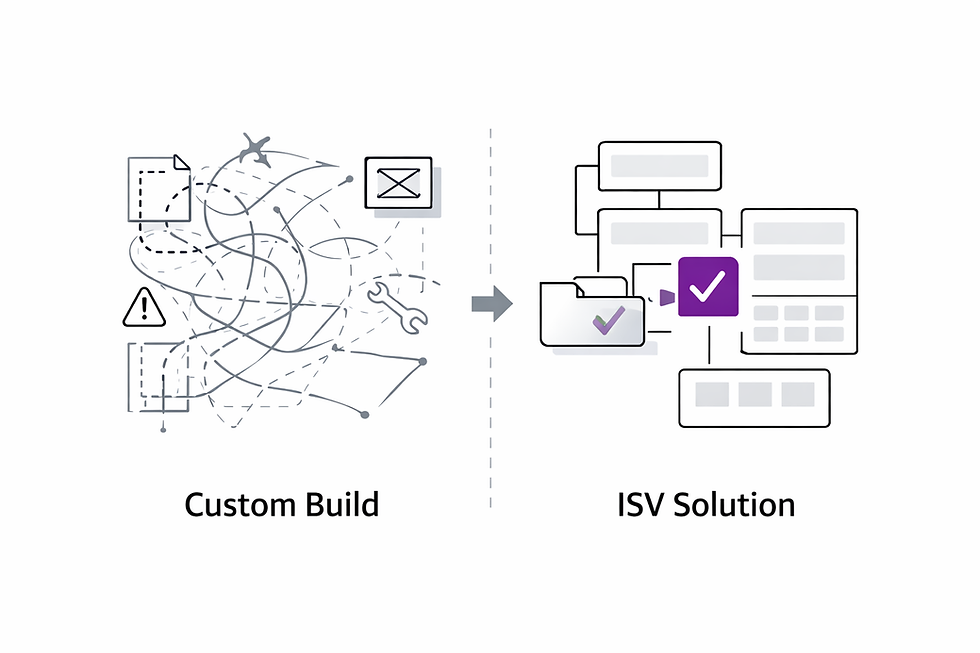
Organizations naturally assume recurring findings point to problems with people, training, or procedures. While those areas certainly matter, the underlying causes are often much harder to see. Information is spread across disconnected systems, quality records are maintained separately, and critical approvals happen outside the workflow. Teams spend valuable time manually connecting information that should already be connected. Over time, operational complexity increases while visibility decreases.
By the time investigators ask for evidence, organizations frequently find themselves reconstructing the story rather than simply retrieving it.
Looking Beyond the Observation
Many recurring findings sound familiar:
Incomplete records
Weak audit trails
Limited traceability
Deviation management issues
Supplier qualification gaps
The typical response is to revise procedures, retrain employees, and increase oversight. While those actions are important, they do not necessarily address the conditions that allowed the issue to occur in the first place.
In many environments:
Manufacturing data resides in the ERP system.
Laboratory information is managed in LIMS.
Quality events are tracked elsewhere.
Supporting documents live on shared drives, spreadsheets, or email chains.
None of these systems are inherently wrong.
The challenge is that compliance increasingly depends on people connecting information manually instead of systems maintaining those connections automatically. Eventually, operational control becomes dependent on tribal knowledge and individual effort.
That is not a sustainable model.
When Inspections Test the System
A typical request during an inspection sounds straightforward: Show the complete history of a batch.
Not just production records, but also:
Raw materials
Laboratory results
Deviations
Approvals
Signatures
Supporting documentation
In theory, the information already exists.
In practice, it often lives across multiple systems. Teams pull reports, compare timestamps, search for documents, and manually piece together the sequence of events.
It is not uncommon to discover:
Records that do not align perfectly
A deviation that is not fully connected to the batch
Missing supporting information
Documents stored outside the controlled process
At that point, the conversation changes. The organization is no longer demonstrating control. It is explaining why control appears incomplete. Regulators are not evaluating how much effort went into gathering the information. They are evaluating whether the information is complete, consistent, and reliable.
Surface-Level Fixes Rarely Solve System-Level Problems
Many organizations spend years strengthening procedures while the underlying operational environment remains unchanged.
Common responses include:
Adding more reviews
Increasing approvals
Retraining employees
Creating additional spreadsheets
Implementing more manual checks
The intention is good, but complexity continues to increase.
Eventually, teams spend more time maintaining the process than improving it.
People should not have to compensate for weaknesses in the system.
Systems should support the people.
Organizations that consistently perform well during inspections are rarely relying on heroic efforts behind the scenes. They have built environments where traceability, approvals, and records remain connected as part of normal operations.
Compliance becomes something they continuously produce, not something they assemble under pressure.
A Simple Exercise
Imagine an investigator asks for the complete history of a batch.
Ask yourself:
How many systems would your team need to access?
How many people would be involved?
Would someone need to manually reconcile information?
Would spreadsheets, emails, or shared drives become part of the process?
Could the information be provided within thirty minutes?
Or would several departments spend hours piecing everything together?
The answers to those questions often reveal far more than the inspection itself. Because the real issue is not whether the information exists. The real question is whether the organization can consistently demonstrate control.
Inspection Readiness Starts Long Before an Inspection
At Maggnumite, we believe strong compliance begins with strong operations.
Organizations that perform well during inspections are usually not doing anything extraordinary when regulators arrive. They are simply operating with systems and processes that support:
Traceability
Accountability
Visibility
Data integrity
Controlled approvals
Reliable records
Every day Form 483 observations rarely appear because one person made one mistake.
More often, they expose weaknesses that have existed for years. Addressing those weaknesses is not just about avoiding warning letters.
It is about building operations that remain reliable, connected, and sustainable as complexity grows.
Because inspection readiness does not begin when auditors arrive. It begins with the way the business operates every day. Organizations that consistently perform well during inspections are rarely preparing for audits. They are operating in a way that continuously produces the evidence regulators expect to see.
If your organization is relying on spreadsheets, disconnected systems, or manual processes to maintain compliance, it may be time to evaluate whether your current approach is supporting long-term operational control.
At Maggnumite, we help Life Science organizations build connected, sustainable operations using Microsoft Dynamics 365 and industry-focused solutions designed for regulated environments.