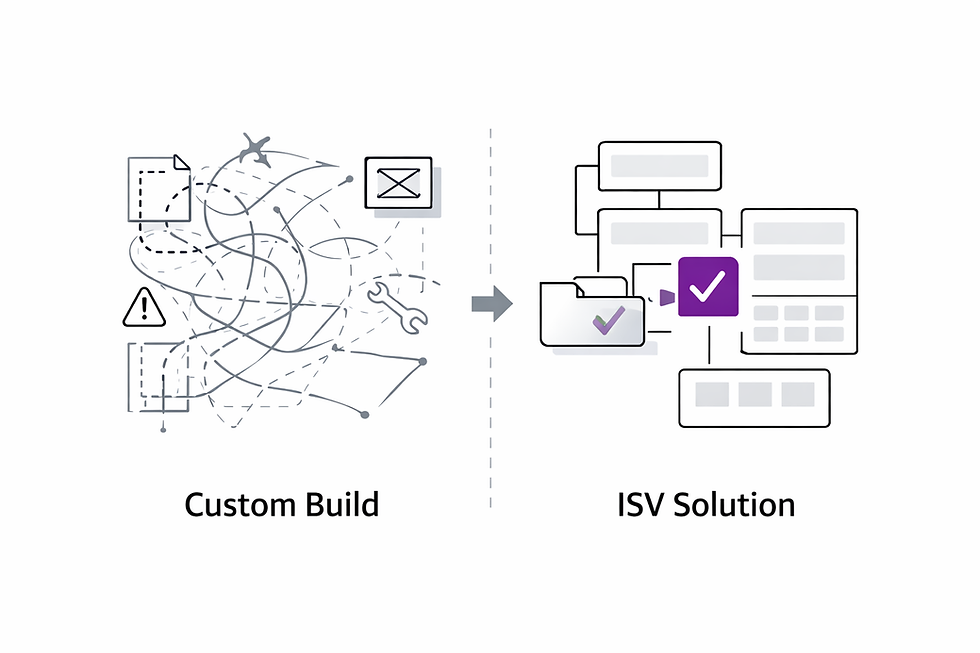
The Hidden Risks of Custom Code — and How Embedded Solutions Avoid Them

Why Teams Default to Custom Code
During a Microsoft Dynamics 365 Finance & Supply Chain implementation, there’s always a moment when your team spots a mismatch:
The ERP doesn’t handle a niche approval step
A form doesn’t display data the way you want
A workflow requires extra compliance checkpoints
The decision point comes fast — do you:
Change your processes to fit Dynamics 365?
Customize the ERP to fit your current workflows?
Use an Independent Software Vendor (ISV) solution to bridge the gap?
Custom code feels attractive because it:
Keeps processes familiar for users, improving adoption
Eliminates the search for and vetting of third-party tools
Avoids license fees for prebuilt solutions
Delivers a “perfect fit” (at least on paper)
But in Life Science — where validation, compliance, and scalability aren’t optional — the short-term gains can turn into costly long-term risks.
The Hidden Risks in Regulated Environments
1. Longer, More Complex Implementations
Every customization adds design, documentation, coding, testing, and validation steps. For regulated industries, that means qualification work that can delay go-live.
2. Misalignment Between Business and Development
It’s common for developers to deliver something that meets the written spec but doesn’t match the business intent — especially if requirements evolve mid-project.
3. Maintenance Burden with Every Microsoft Update
Dynamics 365 updates twice a year. Each update means re-testing and re-validating customizations. A single Microsoft core change can break your code.
4. Knowledge Gaps When People Leave
If the developer who wrote your customization leaves without documentation, you can end up with a black box no one understands — until it breaks.
5. Scalability Problems
A customization built for one legal entity or market may fail in another due to localization, currency, or compliance differences. Expansion often means rewriting.
6. Security and Compliance Risk
Poorly built code can introduce vulnerabilities, expose sensitive data, or fall short of Microsoft’s development best practices — leaving you exposed during audits.
How Embedded Solutions Solve the Same Problems Without the Headaches
Embedded ISV solutions offer the same “ERP gap-filling” benefits as custom code — but without the fragility.
With embedded solutions, you get:
Industry-Specific Features – Prebuilt functionality for GMP compliance, electronic signatures, audit trails, and more.
Update Compatibility – Tested against Microsoft updates before release, reducing downtime risk.
Faster Deployment – Go live in weeks instead of months.
Low-Code / No-Code Configuration – Your team can adapt workflows without deep development work.
Built-In Compliance – Designed with ISO, FDA 21 CFR Part 11, EMA, and other regulatory frameworks in mind.
Lower Long-Term Cost – Reduced maintenance and rework over the ERP’s lifecycle.
For example, instead of building your own GMP traceability module, you can deploy a validated embedded solution that integrates directly into Dynamics 365 — already tested, documented, and ready for inspection.
When Customization Still Makes Sense (and How to Do It Safely)
If your process truly delivers competitive advantage and no ISV solution meets the need, custom code can be justified — but only with guardrails:
Assign Code Ownership – Know who is responsible for maintenance and testing.
Document Everything – Include functional intent, technical design, and validation results.
Plan for Updates – Allocate time and budget for re-validation every Microsoft release cycle.
Test in Multiple Contexts – Ensure scalability across legal entities, currencies, and compliance frameworks.
Maintain Cross-Team Alignment – Regular check-ins between technical and functional teams to avoid misinterpretation.
The Bottom Line
In Life Science, ERP gaps are inevitable — but the way you close them can either set you up for resilience or create a long-term liability.
Custom code offers control, but it brings maintenance risk, compliance headaches, and scalability limits. Embedded ISV solutions give you the same tailored functionality with faster deployment, built-in compliance, and a safer long-term path.
Maggnumite for Life Sciences partners with proven ISV providers to deliver embedded solutions for Microsoft Dynamics 365 that are:
Pre-validated for regulated industries
Update-ready before every Microsoft release
Configurable without heavy code work
Designed for scalability and audit readiness
📅 Book a Demo by contacting us at info@maggnumite.com to see how embedded solutions can keep your ERP fast, compliant, and future-proof — without locking you into costly rebuild cycles.